
Anderson County Criminal Docket Searches
Begin with the Kansas District Court Public Access Portal. Registration and reCAPTCHA are required. Pick Anderson as the location, and a full case number will pull the file fast. You can also narrow a docket search by party name, attorney, or date range. Filters also cover case type, status, and judicial officer. Citation number and cross-reference work too. Smart Search returns public case information, an events index, and links to eligible documents. It will not show every criminal filing or image.
A complete Anderson County criminal docket search keeps a fallback chain ready. The Fourth Judicial District court calendar posts judge-specific PDF calendars of future settings. The Garnett courthouse has public-access computers. Those terminals can display eligible converted documents that the web portal lacks. Need inspection, copies, or certification? Tina Miller, Clerk of the District Court, handles those requests and specific written record requests. Staff will not run broad record searches by phone, per local guidance.
- Sign in to Smart Search and set the location to Anderson.
- Enter the full criminal number or use focused party and date filters.
- Confirm the court header, case status, judge, and chronological events.
- Compare a future setting with the current Anderson judge calendar.
- Use the courthouse terminal or request a specific document from the clerk.
Anderson Criminal Docket Number Eras
Anderson County joined the centralized Kansas eCourt case-management track on November 2, 2020. That date splits docket numbers into two eras. Newer criminal cases carry the form AN-2026-CR-000001. That code packs in a county code, year, case type, and a six-digit sequence. Older files may read simply 2020-CR-000001. Those carry no Anderson prefix. Search only the new format and a valid legacy result can stay hidden.
The letters count too. CR marks the criminal case type observed in Anderson records. Traffic cases use TR, and municipal ordinance matters sit in a city court unless appealed. Did a full number fail? Confirm the year and retry the correct pre- or post-Odyssey form. The official Smart Search instructions walk through current filters and formats.
Search clue: A visible case with no downloadable older filing may point to a kiosk-only converted document, not a sealed case.
Criminal Dockets: What They Show
Read an Anderson County criminal docket as a timeline. Check the header and court first. Then look at the parties and any public charge or count information. From there, follow the filed events in date order. Hearings, motions, orders, pleas, and the final outcome follow the same order. A charge stays an allegation. The docket must record a disposition before that changes, and one case can hold several counts that each end differently.
| Case header | Court, case number, filing date, type, status, judge, and caption. |
|---|---|
| Parties | State or prosecutor role, defendant role, counsel, and pro se status when public. |
| Events | Dated filings, appearances, motions, orders, pleas, and administrative entries. |
| Settings | Date, time, judge, hearing label, appearance mode, and location when shown. |
| Disposition | Plea, verdict, dismissal, diversion, sentence, and public financial data. |
| Access flags | Sealing, redaction, missing images, juvenile limits, or kiosk-only material. |
The public events index is not the full file. Kansas Supreme Court Rule 21 defines electronic case records, while Rule 22 governs public access separately. Even when a certified journal entry or sentencing order appears online, the clerk must issue the certified copy.
Anderson Criminal Calendar Terms
Anderson judge calendars use setting labels, and a label says what is scheduled, not what happened. A PDF may list a bond appearance, status conference, preliminary hearing, bench trial, jury trial, diversion review, plea and sentencing, probation review, or a court review with no appearance. A Zoom notation only describes how the appearance happens. It never changes the case type.
- First appearance
- An early hearing for custody, counsel, and initial case handling.
- Arraignment
- An appearance at which the charge is addressed and a plea may be entered.
- Preliminary hearing
- A probable-cause hearing before a felony proceeds toward trial.
- Status conference
- A progress and scheduling hearing, not a judgment.
- Disposition
- The outcome, such as dismissal, plea, conviction, acquittal, or diversion.
A "Diversion-Status" line is just an ordinary setting. It does not prove Anderson County runs a separate diversion court, and the official specialty-court list names no dedicated Anderson drug or treatment docket.
Criminal Case Stages on the Docket
A common sequence is Filing → First Appearance → Preliminary Hearing → Arraignment → Pretrial → Plea or Trial → Disposition → Sentencing. Not every Anderson County criminal docket uses every step. Misdemeanor procedure differs from felony procedure, and a dismissal or diversion can change the path. A continuance can leave an earlier setting visible while a newer event supplies the controlling date.
A magistrate judge in Anderson County takes felony first appearances, preliminary examinations, arraignments, and most misdemeanor work under K.S.A. 20-302b. District judges keep the matters that need their authority, along with jury trials and sentencing. The division listed on a docket entry just reflects one stage of the case. It never means two separate criminal files exist.
Read each journal entry and order after a hearing. An arraignment is not a conviction. A pretrial conference is not a trial. If the calendar and the portal disagree about a setting, call the clerk of the district court, since the calendar is only a generated snapshot that can lag behind the real docket.
Anderson Criminal Docket Outcomes
Want a sense of how criminal cases in Anderson County actually end? The Kansas FY2025 Criminal Dispositions report counts the finished ones statewide. For the period ending June 30, 2025, it lists 62 felony dispositions and 59 misdemeanor dispositions. Those are completed outcomes, though. They are not open cases on a court docket. These are not filings, and not individual people.
The Anderson County criminal docket breaks down by offense class. Felonies show 42 guilty pleas and 14 dismissals. They add one deferred result, four other results, and one jury trial. Misdemeanors look different: 15 guilty pleas, 29 dismissals, ten deferred results, four other results, and one court trial. Dismissals actually outnumber guilty pleas at that level.
The detail behind these figures includes one felony conviction and one misdemeanor acquittal. The mix tells you how often pleas, dismissals, diversions, and trials appear on the docket. It cannot tell you why any single case ended the way it did.
Anderson County Criminal Docket Courts
State felony and misdemeanor cases belong to Anderson County District Court. The district magistrate docket handles statutory early and limited stages. The district judge takes assigned work. That work requires district-judge authority. The Anderson County Attorney prosecutes state matters but does not keep the docket. Tina Miller, Clerk of the District Court, maintains the district and magistrate records.
| Court or office | Role | Record route |
|---|---|---|
| Anderson District Court | State felony and misdemeanor docket | Smart Search, terminal, clerk |
| District magistrate docket | Early felony stages and misdemeanor authority | District-court channels |
| Municipal court | City ordinance cases | City court until appeal |
| County Attorney | Prosecution | Not the custodian |
Per the Fourth Judicial District Anderson page, the court sits at 100 E. 4th Avenue, Garnett, with mail to P.O. Box 305. The clerk phone is (785) 448-6886. Posted hours run Monday through Friday, 8 a.m. to noon and 1 p.m. to 4 p.m.
State and Federal Dockets Differ
Smart Search docket results for Anderson County criminal cases reach only Kansas state records. Federal district cases sit elsewhere. The District of Kansas CM/ECF interface is the access point for federal dockets, with PACER providing public federal case records.
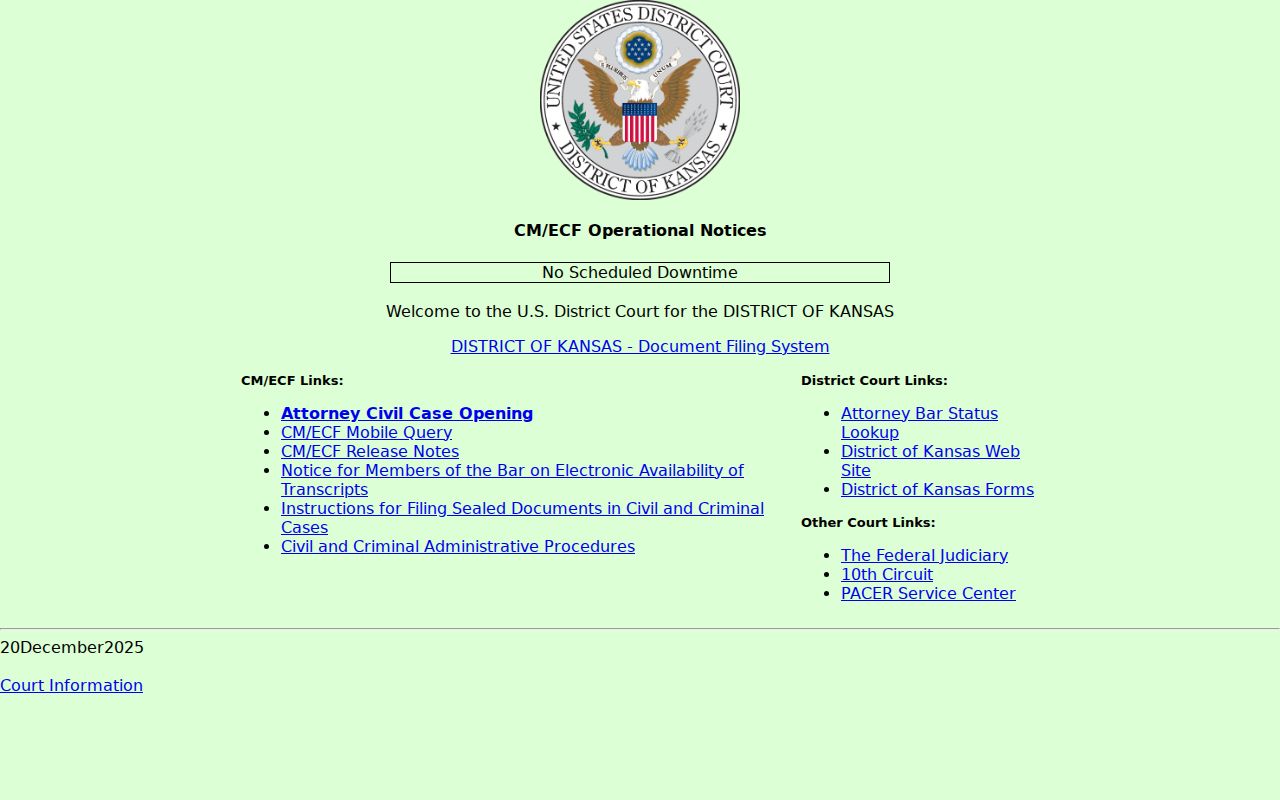
That federal screen also means a blank Smart Search result tells you nothing about federal cases; a matter can exist there without ever touching the state docket. Bankruptcy runs on its own track. The U.S. Bankruptcy Court for Kansas CM/ECF page lays out that court's filing system and its PACER access.
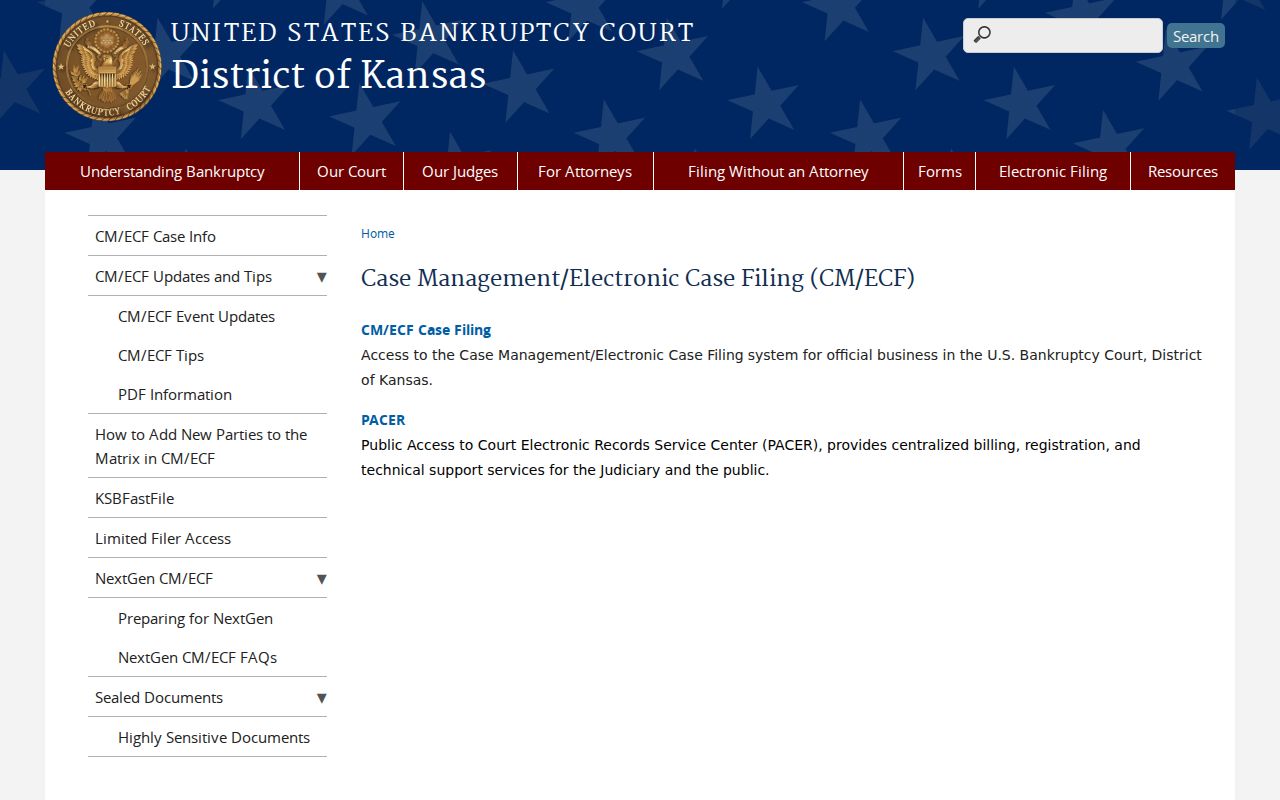
The takeaway holds across every portal you meet. Search the court that actually holds the case, not any site that flashes the word "case."
When Anderson Criminal Documents Vanish
A calendar entry without a linked document does not mean the document never existed. Older converted public documents may live only at the courthouse kiosk. Some images are simply not exposed online. Juvenile-sensitive, expunged, sealed, and other nonpublic material carries its own limits. Before contacting the clerk, jot down the case number. Add the event date, document title, and the source you checked.
Try the portal link first, then the free terminal. Is the item still missing? Ask whether it is web-excluded, kiosk-only, or restricted. It may also be obtainable through a written Kansas Open Records Act request. Requesting one named document is different from asking staff to compile a broad history. When authorized, the clerk can hand you plain or certified copies.
Anderson Clerk of District Court
100 E. 4th Avenue, Garnett, KS 66032
P.O. Box 305
(785) 448-6886
Monday-Friday, 8-12 and 1-4
One caution: this office is not the county-government clerk. Both work out of the courthouse, yet their duties differ.
Access Rules for Criminal Dockets
Anderson County criminal docket information open to the public may come through Smart Search, a courthouse terminal, a current judge calendar, clerk inspection, or a focused request. For some converted records, the terminal reaches farther than the web. No terminal can open a sealed case. What you can see depends on case type, the document, the statute, the rule, and any court order.
Key rules:
Kansas Supreme Court Rule 22 permits public events-index and case-record access while excluding sealed and nonpublic records.
K.S.A. 45-216 favors inspection unless an exception applies.
K.S.A. 45-221 lists exemptions and preserves release of separable public portions where required.
K.S.A. 22-2410 governs expunged arrest records and limited disclosure.
A name that turns up empty does not prove sealing or expungement, so verify with the lawful custodian. For filed documents, start with Anderson County Court Case Records.