
Anderson County Court Record Requests
Start with the Kansas District Court Public Access Portal. Pull up the Anderson case and check whether the document you want carries a public link. If the case shows but an older image stays dark, visit the courthouse kiosk at 100 E. 4th Avenue in Garnett. Filings converted from the pre-Odyssey system can be terminal-only.
- Locate the case number through Smart Search, a court notice, or the judge calendar.
- Write down the document title or type, filing date, and related docket event.
- Check the public web link, then the Anderson courthouse terminal if needed.
- Ask Tina Miller, Clerk of the District Court, for inspection, a plain copy, a certified copy, or older-file help.
- Use the Kansas court-records KORA form when a specific written request is appropriate.
- For a transcript, identify the hearing date and ask the clerk or court reporter about the separate transcript process.
Call the staff to get routed and hear the hours. The Fourth District, though, does not run record searches by phone. Mail goes to P.O. Box 305, Garnett, KS 66032. Fax works at (785) 448-3230 when the form or clerk allows it, and you should confirm email acceptance before treating email as a formal request.
The Anderson Clerk Distinction
Tina Miller is the Clerk of the District Court for Anderson County. Her office holds the district and magistrate files. These include criminal, traffic, civil, domestic, probate, juvenile, small claims, and the rest. Julie Wettstein, the Anderson County Clerk, runs a county-government office instead. She is not the district-court docket clerk. Both offices sit inside the same courthouse. That is why people mix them up.
Correct recipient: Identify Anderson County District Court on a judicial records request and do not send it to the county-government clerk merely because the offices share the courthouse.
Municipal courts sit outside this system too. City clerks keep the ordinance and municipal traffic files. So a Garnett municipal case starts with the city court, not the district clerk. Only an appeal or a new district-court proceeding creates an Anderson District Court file.
Kinds of Anderson County Court Records
The word record can describe four products with different access and authentication.
- A judge-specific calendar PDF lists future settings and is a generated, reference-only snapshot.
- The case information and events index shows public identifiers, status, events, and eligible links.
- A filed document can be a petition, complaint, answer, motion, order, journal entry, judgment, decree, or exhibit.
- A certified copy is clerk-authenticated; a transcript is a separate verbatim proceeding record prepared through the reporter or transcription process.
- A municipal record belongs to the city court, while a federal record belongs to the U.S. District Court for the District of Kansas.
A portal printout is no substitute for a certified judgment. The calendar, likewise, is not the whole case file. Name the exact product you want so the clerk can match it to the right source, fee category, and delivery route.
Four Anderson Records, Four Uses
Tracking a hearing? The current calendar and events index may be all you need. Documenting a signed ruling calls for the journal entry or judgment. Formal purposes can require certification. A word-for-word account of testimony means ordering a transcript.
| Record | Source | Key limit |
|---|---|---|
| Calendar PDF | Fourth District calendar hub | Generated snapshot that may not include a recent change |
| Events index | Smart Search or courthouse kiosk | Index is not every filed image |
| Filed document | Portal link, kiosk, or clerk request | Access depends on type, date, and restriction |
| Certified copy | Clerk of the District Court | Separate request and locally determined fee |
| Transcript | Court reporter or approved process | Separate estimate and production timeline |
Court Records: What They Contain
Read a public case file document by document and event by event rather than assuming every category exists in every matter.
| Case Number | The unique identifier, often AN-YYYY-TYPE-###### for post-November 2, 2020 cases. |
|---|---|
| Caption and Court | The case style, Anderson County District Court, and public party roles. |
| Pleadings | Petitions, complaints, answers, motions, and responses filed by parties. |
| Orders and Judgments | Signed rulings, journal entries, decrees, or final judgments. |
| Docket or Events Index | The chronological public record of filings, settings, and actions. |
| Exhibits and Attachments | Filed supporting material, subject to access and redaction rules. |
| File Stamp and Links | Filing date and time, document title, related event, and eligible image. |
| Redaction or Restriction | Protected identifiers, sealed labels, suppressed fields, or missing-image notices. |
How to Complete the Kansas KORA Form
The official Kansas Court Records Request Form starts with the recipient. Choose the Kansas Supreme Court, the Kansas Court of Appeals, a named county district court, or another office. For this file, that entry is Anderson County District Court. Add your name and contact information. Then pick email, mail, in-person pickup, or fax as the delivery method.
Fill the Records Requested box with care. Give the case number, document title, date, and copy type. The form carries a commercial-purpose certification under K.S.A. 45-230, a signature and date line, and custodian space for an estimated reproduction cost. It promises no universal turnaround and demands no government ID on its face. It publishes no single copy fee. A vague grab for everything moves slower than a request for one identified public journal entry.
Copy Fees and Certification
Anderson County publishes no current fee schedule for plain pages, certification, exemplification, docket sheets, staff searches, fax, or document images. Kansas rules let district courts set reasonable copying and certification charges. Ask the clerk for the current amount, the accepted payment method, an estimate, and whether advance payment is required.
| Item | Anderson fee status |
|---|---|
| Plain copy | Current official local amount not located; confirm with clerk |
| Certified copy | Current official local amount not located; confirm with clerk |
| Exemplified copy | Current official local amount not located; ask about authentication needs |
| Docket or events-index print | Current official local amount not located |
| Transcript | Separate reporter estimate; no Anderson schedule located |
Anderson County Clerk of the District Court
100 E. 4th Avenue
P.O. Box 305
Garnett, KS 66032
(785) 448-6886
Monday-Friday, 8 a.m.-noon and 1-4 p.m.
Three Business Days Is Not Completion
Under K.S.A. 45-218, an agency should act on a public-record request as soon as possible. The deadline is the end of the third business day. That clock does not guarantee a complex file, certified copy, or transcript within three days. What arrives may vary. It could be the record itself, an estimate, a request for clarification or payment, a timeline, or the legal basis for withholding.
Send a request to the wrong custodian. The statute directs you to the proper one. The custodian may need enough detail to identify the item. Advance payment of estimated reproduction costs may also be required. Part of a record may be exempt. Ask whether a reasonably separable public portion can come out.
Access Rules for Court Records
Public access to district-court case records runs through Kansas Supreme Court Rule 22. It sorts material into public portal, courthouse terminal, and nonpublic tiers. The Kansas Open Records Act policy in K.S.A. 45-216 tilts toward inspection of public records unless an exception applies. K.S.A. 45-221 lists what may be withheld. It also supports releasing separable nonexempt portions where required.
Key access rule: A courthouse terminal can expose public web-excluded material, but neither the terminal nor a written request makes a sealed or legally nonpublic record public.
Sensitive categories carry their own limits: adoption, domestic, CINC, juvenile, guardianship, conservatorship, and care-and-treatment records. Local Anderson guidance sends divorce, visitation, support, and paternity questions to the courthouse rather than online search. Expunged or sealed material stays governed by statute and court order.
Anderson Redaction and Missing Images
An image missing from the Anderson County docket portal has several possible causes. The filing may predate Odyssey conversion or fall under a web-excluded case type. It may be sealed or redacted. Or it may simply not be offered as a public portal document. Absence from Smart Search is not absence from the official court file.
When you contact the clerk, bring the case number, the document title, and the filed date. Also bring the channel you already checked. Ask whether the item sits at the kiosk only, exists as a public copy, is restricted, or needs redaction. Public copies can suppress protected identifiers and sealed attachments. Rule 22 also bars demanding that the clerk compile or bulk-distribute a new database. It requires production of identified records instead.
Anderson Forms and Federal Records
Local paperwork for Anderson County cases comes through the Fourth Judicial District forms directory. It includes a continuance request and a traffic trial request. A payment-plan journal entry is there too. Community-service forms round out the set. A form helps you name the court action you want. Filing instructions, though, must come from the court itself, and staff cannot give legal advice. The directory page shows the full set of local resources. These serve Anderson County record users directly.
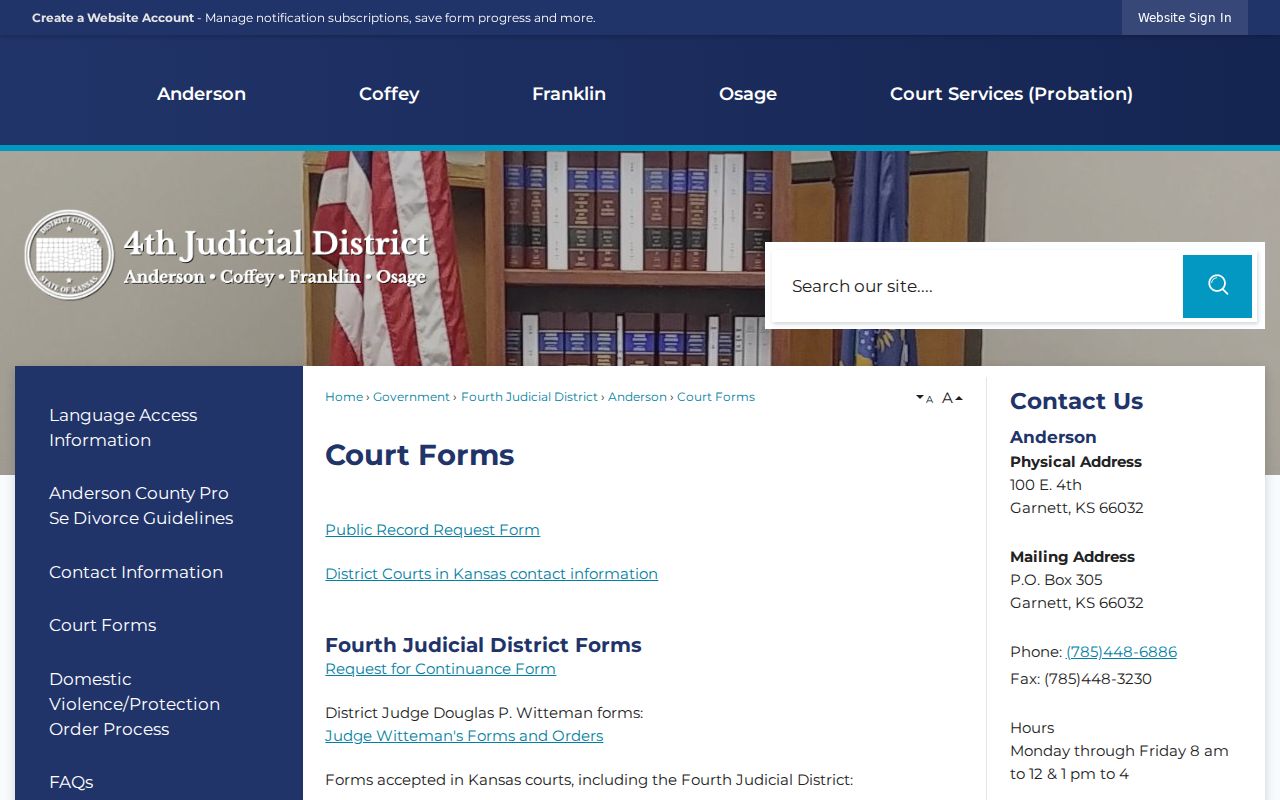
None of these district forms will retrieve a federal file. Federal records that touch Anderson County live with the U.S. District Court for the District of Kansas, not the Anderson clerk. For that separate route, the federal court records access page spells out how federal case lookup works.
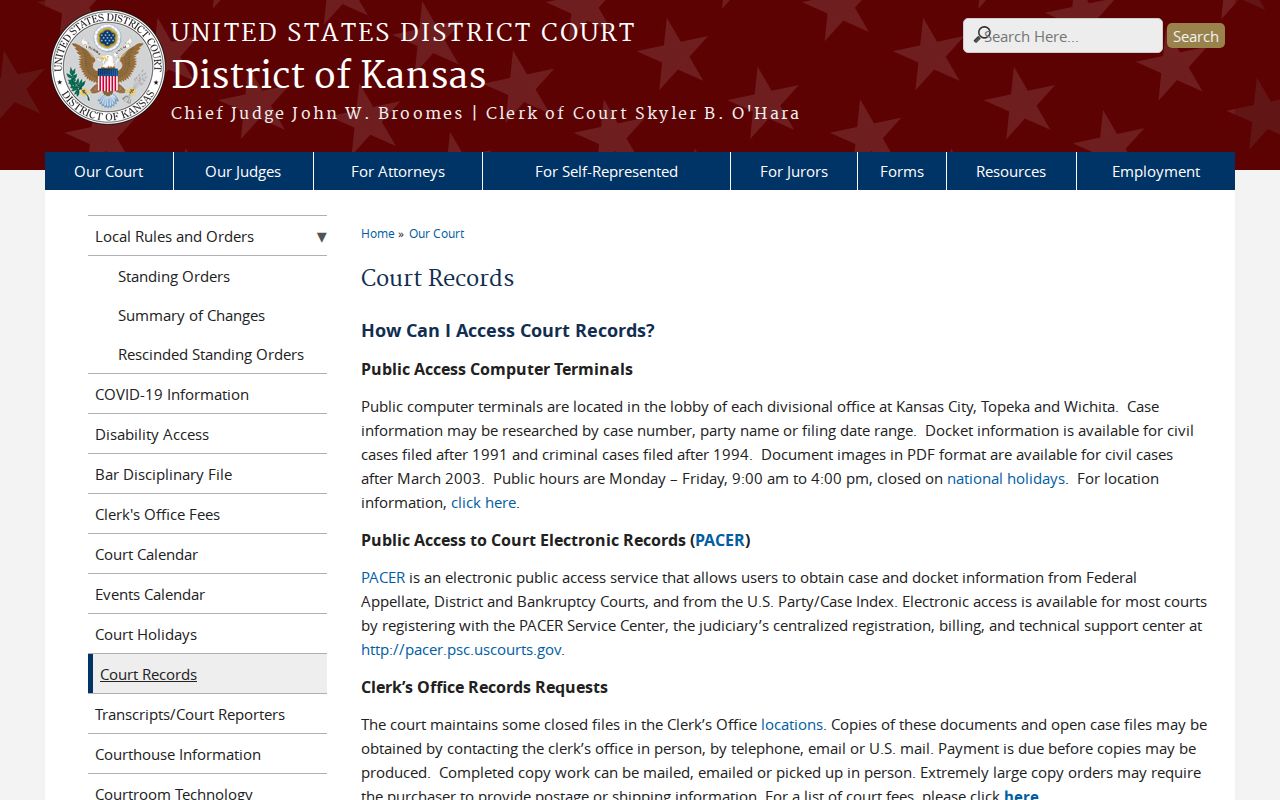
The custody split is clear. State district records stay with Anderson County District Court, while federal dockets and documents run through federal court systems.